Exam Revision Planner Preview
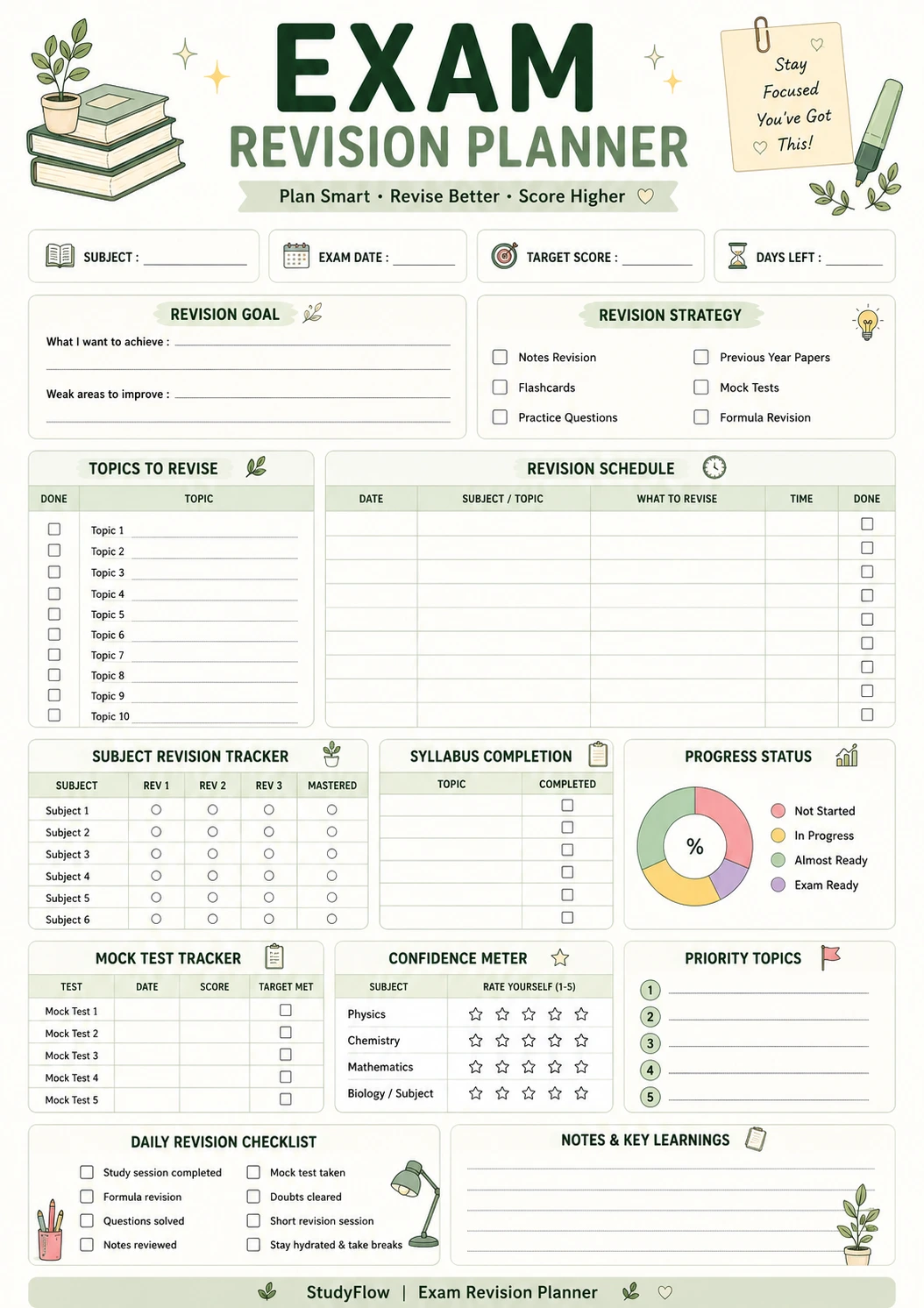
Exam Revision Planner: How to Plan Your Revision and Prepare for Exams
Preparing for exams can feel challenging when several subjects, chapters, assignments, and deadlines compete for your attention. You may know that you need to revise, but deciding what to study first, how much time to spend on each topic, and how to check your understanding can be difficult. Without a clear plan, it is easy to spend too much time on familiar topics while leaving difficult material until the last minute. An exam revision planner helps you organize your preparation, divide the syllabus into manageable sections, and see what needs your attention before exam day.
An effective revision plan is not simply a timetable filled with long study sessions. It is a practical system that combines reviewing material, testing your knowledge, practising exam-style questions, and revisiting topics you find difficult. It also leaves room for breaks, regular responsibilities, and unexpected changes. Whether you are preparing for school examinations, college assessments, or an important set of tests, a revision planner can help you approach your preparation with greater clarity and make better use of the time available.
What Is an Exam Revision Planner?
An exam revision planner is a tool for organizing the subjects and topics you need to review before an examination. It can be a printable worksheet, a notebook, a spreadsheet, or a digital planner. A typical revision planner includes exam dates, subject names, topic lists, planned revision sessions, practice activities, and a way to record your confidence or progress.
For example, if you have an upcoming mathematics examination, your planner might list algebra, geometry, equations, and other topics included in your syllabus. You can assign revision sessions to each topic, record the questions you have practised, and note which areas need another review. This gives you a clearer picture of your preparation than relying on memory alone.
An exam revision planner is different from a general study timetable. A timetable focuses on when you plan to study, while a revision planner also helps you decide what you will revise, how you will practise it, and which areas need further attention. You can use both together: the revision planner organizes the content, and the timetable gives each activity a place in your day.
Why Is an Exam Revision Planner Important?
It Helps You Cover the Syllabus
When an examination includes many chapters or topics, it can be difficult to remember everything that needs revision. Writing down the syllabus gives you a clear overview of the material you are responsible for preparing.
Once you have listed the topics, you can distribute them across the days or weeks available. This reduces the chance of spending most of your preparation time on the first few chapters and overlooking the rest.
It Helps You Identify Weak Areas
Not every topic requires the same amount of revision. You may understand some concepts well but struggle with others, especially when questions require you to apply what you have learned.
A revision planner lets you record which topics feel comfortable, which need more practice, and which remain confusing. You can then give additional attention to the areas that need it instead of following the syllabus mechanically from beginning to end.
It Makes Preparation More Manageable
A large examination syllabus can feel overwhelming when you view it as one enormous task. Breaking it into smaller sections makes it easier to decide what to do next.
Instead of writing “revise the entire chemistry syllabus,” you might schedule one topic, a short set of questions, and a review of your mistakes. Completing these smaller steps gives you useful feedback and helps you keep your preparation organized.
It Reduces Last-Minute Confusion
Planning in advance gives you more opportunities to revisit topics and discover misunderstandings before the examination. You can also schedule practice papers and reserve time for reviewing mistakes.
Although no planner can remove every exam-related worry or guarantee a particular result, having a clear plan can reduce uncertainty about where to begin and what to work on next.
How to Create an Effective Exam Revision Plan
Step 1: Write Down Your Exam Dates
Begin by listing your examinations in chronological order. Include the date, subject, and any relevant details about the examination format. Check your school or course information to confirm the dates and the material that will be covered.
Knowing the exam schedule helps you work backward from each examination. A subject with an earlier exam may need immediate attention, while a later exam still requires regular preparation so that you do not leave everything until the final few days.
Step 2: List Every Topic You Need to Revise
For each subject, write down the chapters, units, concepts, formulas, or other material included in the syllabus. Use your course outline, class notes, or official study materials to make the list as complete as possible.
Divide broad chapters into smaller topics when necessary. A single chapter may contain several concepts that require different types of practice. Listing them separately helps you plan revision sessions more accurately and identify gaps in your understanding.
Step 3: Assess Your Current Understanding
Before assigning time to every topic, briefly assess what you already know. Try answering a few questions, explaining a concept from memory, or reviewing a previous practice exercise.
You can use a simple three-level system:
Confident: You can explain the main ideas and answer relevant questions with reasonable accuracy.
Needs review: You understand much of the material but forget details or make occasional mistakes.
Needs more practice: You struggle to explain the topic or solve questions without help.
These labels are planning tools, not permanent judgments about your ability. Update them as you revise and practise. A topic that feels difficult today may become much clearer after a few focused sessions.
Step 4: Prioritize Your Revision Topics
Once you have assessed the syllabus, decide which topics deserve the most attention. Consider your current understanding, the time available, the exam format, and the importance of each topic within your course.
A difficult topic that appears regularly in the types of questions you are expected to answer may deserve more practice than material you already understand well. At the same time, avoid ignoring easier topics completely. They may still be important parts of the syllabus.
The aim is to distribute your effort thoughtfully rather than give every chapter exactly the same amount of time regardless of need.
Step 5: Create a Realistic Revision Timetable
Assign your topics to specific days and study periods. Begin with your existing commitments, such as classes, meals, appointments, and other responsibilities. Then identify the time available for revision.
Try to give each session a clear purpose. For example, you might plan to review a particular biology concept, answer a set of mathematics questions, or practise an essay outline. Clear goals make it easier to begin and help you evaluate whether the session was useful.
Leave some flexible time in your schedule. A topic may take longer than expected, or you may discover that a concept needs additional explanation. A plan that allows adjustments is more useful than a timetable that becomes impossible to follow after one unexpected change.
Step 6: Schedule Repeated Revision Sessions
Avoid treating each topic as something you only need to study once. Plan to revisit important material after some time has passed. During the first session, you might review the concept and clarify confusing points. During a later session, you can try recalling it without notes and answering practice questions.
Spacing revision across multiple sessions gives you repeated opportunities to retrieve and strengthen what you have learned. The exact intervals depend on how much time remains before your exam, how difficult the topic is, and how well you can recall it.
Step 7: Practise Exam-Style Questions
Revision should include more than reading notes or highlighting important sentences. Make room for questions that require you to retrieve information, explain concepts, solve problems, or apply what you have learned.
If past papers are available and relevant to your examination, use them to become familiar with the question format and level of detail expected. You can also use textbook exercises, sample questions, or practice tests provided by your teacher.
After completing a set of questions, check your answers carefully. Record the mistakes you made and identify whether they came from a misunderstanding, forgotten information, a calculation error, or difficulty interpreting the question. Use these observations to plan your next revision session.
Study Techniques to Include in Your Revision Planner
Active Recall
Active recall means trying to retrieve information from memory rather than immediately looking at your notes. After reviewing a topic, close your book and explain the main ideas in your own words. You could also answer flashcards, write down key points from memory, or solve a question without checking an example first.
Once you have attempted the task, compare your response with your notes or a reliable answer. Pay particular attention to the details you missed or misunderstood. Your mistakes show you what to revise next.
You can make active recall a specific planner task by writing “answer five questions without notes” instead of simply “read chapter.” This gives your revision session a clear purpose.
Spaced Revision
Spaced revision involves revisiting material across separate sessions rather than concentrating all your effort in one sitting. For example, you might review a topic when you first study it, test yourself again a few days later, and revisit it during a later revision session.
This approach helps you discover whether you can still recall the material after a gap. If you find it difficult, you can review the concept and schedule another opportunity to practise it.
Your revision planner can record the dates of these sessions so that important topics do not disappear from your schedule after the first review.
Practice Papers and Timed Questions
Practice papers help you apply your knowledge to the types of questions you may encounter in an examination. They can also help you notice whether you need more work on understanding questions, organizing answers, checking calculations, or managing the time available.
Start with individual questions if you are unfamiliar with a topic. As your preparation develops, you can attempt longer sections or complete a practice paper under conditions similar to those of the actual exam, when appropriate.
Afterward, review both your correct and incorrect answers. A practice paper is most useful when you use the results to decide what to practise next.
Summary Notes and Concept Maps
Short summaries, diagrams, and concept maps can help you organize information and understand how different ideas connect. They are particularly useful when a subject contains processes, related concepts, definitions, or complex relationships.
However, creating notes should not consume all your revision time. Once you have made a summary, use it to test yourself. Try recreating the diagram from memory or explaining the main points without looking at the original material.
How to Use a Revision Planner During the Final Week
The final week before an examination is a useful time to review your preparation and focus on the areas that still need attention. Begin by checking your topic list and identifying the concepts you find most difficult to recall or apply.
Organize your remaining sessions around these priorities while continuing to review other important topics. Include practice questions and, where suitable, a practice paper. Leave time to check mistakes rather than completing one paper after another without reviewing the results.
Avoid trying to create a completely new study system at the last moment. Use the planner you already understand, keep your daily targets realistic, and make adjustments based on what you have learned from your practice.
Also, protect time for meals, rest, and adequate sleep. Staying awake for excessively long study sessions can leave you tired and make concentration more difficult. A sensible revision plan supports preparation while leaving room for the rest your mind and body need.
If you discover a major gap in your understanding, consider asking a teacher, tutor, or classmate for clarification. You do not have to solve every difficulty alone, and identifying a problem early gives you a better chance to address it.
Common Exam Revision Planning Mistakes
Trying to Revise Everything in One Day
A long list of topics can create pressure to complete too much at once. Instead, divide the syllabus across the time available and decide which topics require repeated practice. If you are starting late, prioritize carefully rather than creating an unrealistic schedule that leaves no room for breaks.
Spending Too Much Time on Familiar Topics
Reviewing material you already understand can feel comfortable, but it may not address the areas where you need the most improvement. Use questions and self-testing to check your understanding, then direct more time toward the gaps you discover.
Confusing Reading With Knowing
Recognizing a paragraph while reading it is not the same as being able to explain the concept or answer a question independently. Combine reading with recall, practice questions, and explanations in your own words to get a clearer picture of what you know.
Ignoring Mistakes
Repeatedly completing questions without examining incorrect answers can make it harder to improve. Keep a short list of mistakes or concepts that need attention. Revisit this list during later sessions and check whether you can now answer similar questions correctly.
Making the Timetable Too Rigid
Your original plan may need to change as you discover which topics are difficult or how long tasks actually take. Adjusting the timetable is part of effective planning. The aim is to prepare well, not to follow every time slot perfectly.
How to Use a Printable Exam Revision Planner
A printable exam revision planner gives you one place to organize your exam dates, subjects, topics, and revision sessions. You can keep it in a binder, place it beside your study materials, or use it with your daily and weekly study planners.
Begin by entering your examination dates and listing the material covered in each subject. Rate your current understanding of the topics, then allocate revision sessions according to your priorities and available time. As you work through the syllabus, record completed sessions and note the areas that need another review.
If your planner includes a notes section, use it to record difficult questions, common mistakes, or topics you want to ask your teacher about. This makes it easier to decide what to do during your next study session instead of starting from scratch each time.
Keep the process simple and consistent. You do not need to fill every box or decorate the page extensively. A useful planner is one that helps you see what remains, choose the next action, and make adjustments as your preparation develops.
Combine Your Exam Revision Planner With a Daily Study Planner
Your exam revision planner and daily study planner can work together without duplicating all the information. The revision planner holds the broader picture: your examination dates, syllabus topics, and areas that need further work. The daily planner turns those priorities into specific activities for today.
For example, your revision planner may show that you need to practise geometry before an upcoming mathematics exam. Your daily planner can specify which problems you will attempt, how much time you intend to spend, and when you will review the mistakes.
This combination helps you stay aware of the overall syllabus while making each day's work more manageable. If a topic takes longer than expected, update the revision plan and move the remaining work to a suitable session.
Prepare With a Clear Plan, Not Perfect Pressure
Effective exam revision is built around preparation, practice, and regular review. Start by listing your examination dates and syllabus topics. Assess your current understanding, prioritize the areas that need attention, and spread revision across manageable sessions. Use active recall and practice questions to check what you know, then use your mistakes to guide future revision.
Your plan does not need to be perfect from the beginning. It should become more useful as you learn how long tasks take and which topics require extra practice. Leave room for breaks, keep your expectations realistic, and adjust the schedule when circumstances change.
Start with the next examination on your calendar. Write down the topics you need to cover, choose one useful revision task, and decide when you will work on it. A clear, flexible plan can help you use your preparation time more thoughtfully and approach exam day with a better understanding of what you have practised and what still needs attention.