Daily Study Planner
Daily Study Planner Preview
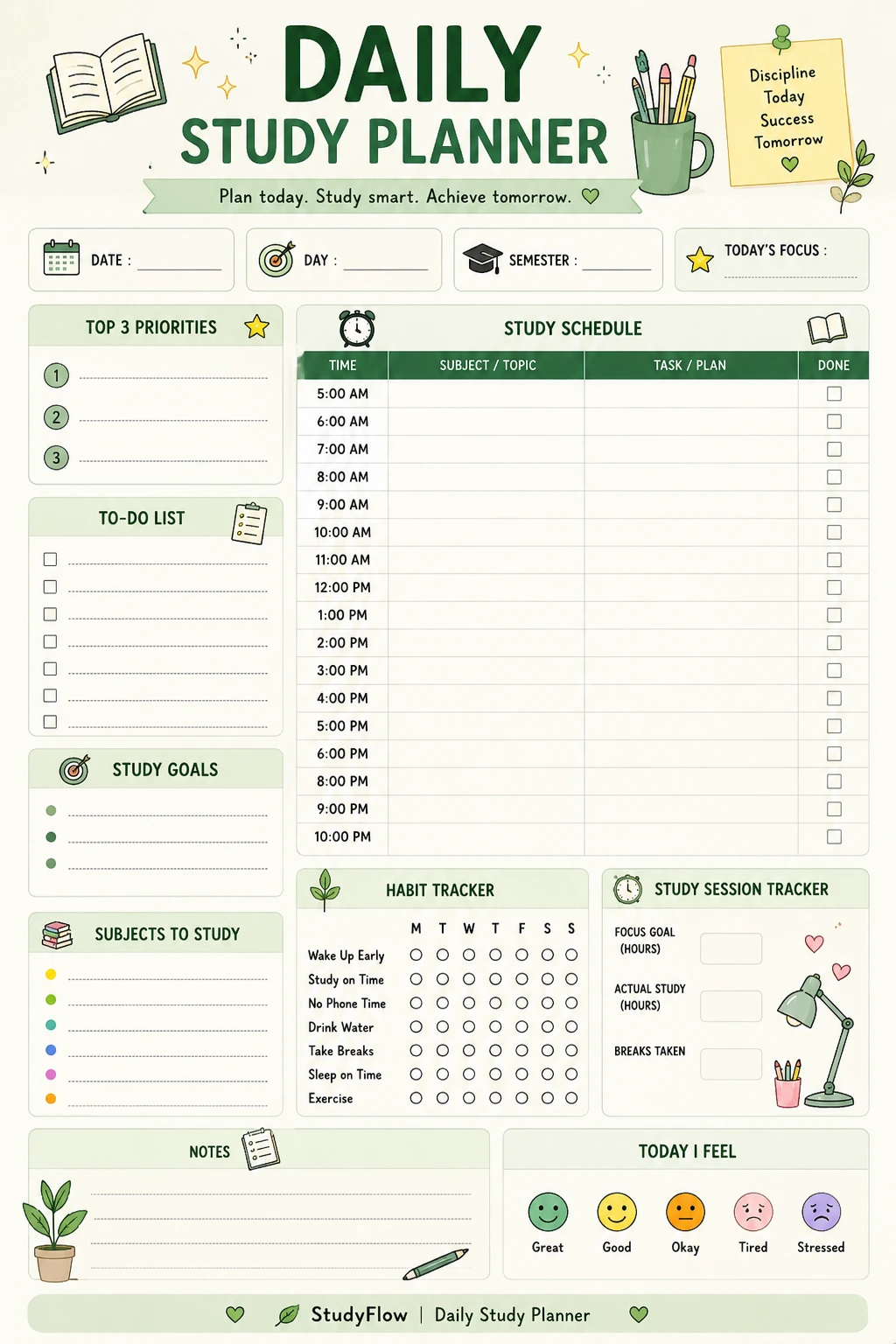
Daily Study Planner: How to Plan Your Day and Study More Effectively
A productive study day does not have to be packed with tasks from morning to night. Often, the biggest difference comes from knowing what needs your attention, deciding when to work on it, and having a realistic plan to follow. Students may have classes to attend, assignments to complete, chapters to revise, exams to prepare for, and personal responsibilities to manage. Without a clear plan, it can be difficult to decide where to begin. A daily study planner helps bring these responsibilities together so you can approach your day with greater clarity and less last-minute confusion.
A daily study planner is useful whether you prefer writing on paper or organizing your schedule digitally. It gives you a place to list important tasks, assign time to your priorities, track completed work, and prepare for the following day. Most importantly, it encourages you to turn broad intentions into manageable actions. Instead of writing “study science,” for example, you can plan to revise one topic, answer practice questions, and review the concepts you found difficult. With a simple system and regular adjustments, planning can become a practical part of your study routine rather than another task to worry about.
What Is a Daily Study Planner?
A daily study planner is a tool that helps you organize your academic tasks and other daily commitments. It may include a schedule, a priority list, assignment reminders, study-session goals, and a small section for reflecting on your progress. Some planners use hourly time slots, while others divide the day into morning, afternoon, and evening. The best format depends on how much structure you need and how predictable your schedule is.
Unlike a general to-do list, a daily study planner can help you decide not only what needs to be done but also when you intend to do it. Writing “complete mathematics practice” on a list identifies a task. Scheduling a specific period to solve ten questions gives that task a clearer place in your day. You can then compare your plan with what actually happened and adjust your approach when necessary.
A daily planner also works well alongside a weekly study planner. Your weekly plan gives you an overview of upcoming deadlines, lessons, and important commitments. Your daily plan turns that overview into a manageable set of actions. Together, they help connect long-term academic goals with the work you can realistically complete today.
Why Is Daily Study Planning Important?
It Helps You Decide What to Do First
When several assignments and revision tasks compete for your attention, choosing the first one can become surprisingly difficult. A daily planner allows you to identify the tasks that matter most before you begin studying. You can consider deadlines, the difficulty of the material, and how much work remains, then choose a sensible starting point.
This does not mean that every urgent task must always come first. Some important work needs attention well before its deadline. Beginning an assignment early, for instance, gives you time to research, write, review, and make improvements instead of rushing through everything at the last minute.
It Makes Large Tasks Easier to Manage
A task such as preparing for an entire examination can feel overwhelming because it contains many smaller activities. A planner helps you divide it into steps, such as reviewing a chapter, practising questions, checking mistakes, and revisiting difficult concepts.
Smaller tasks give you a clearer starting point and make it easier to estimate how much time you need. If a task turns out to be more difficult than expected, you can adjust the remaining plan rather than treating the entire day as unsuccessful.
It Creates a More Realistic Routine
It is easy to create an ideal schedule that looks perfect on paper but does not fit your actual day. Classes may run longer than expected, household responsibilities may arise, or a difficult topic may require additional attention. A useful study planner accounts for these possibilities.
Include your existing commitments, meals, breaks, and personal time before allocating the remaining time to study. This helps you build a plan around your real responsibilities rather than expecting every available minute to be productive.
It Helps You Reflect on Your Progress
At the end of the day, your planner provides a simple record of what you completed and what still needs attention. You can identify tasks that regularly take longer than expected, notice when distractions interfere with studying, and decide what changes might help tomorrow.
The purpose is not to criticize yourself for unfinished work. It is to understand your habits and use that information to create a more workable plan.
How to Make a Daily Study Plan Step by Step
Step 1: Review Your Responsibilities
Before writing your study tasks, check what is already scheduled for the day. Include classes, tutoring sessions, appointments, family commitments, extracurricular activities, and any fixed deadlines. These commitments determine how much flexible time is actually available.
Next, check your assignments and upcoming assessments. Look beyond the current day: if a test is approaching or a project has several stages, make sure your daily plan includes a reasonable step toward preparing for it. This prevents important work from being overlooked simply because it is not due today.
Step 2: Choose Your Main Priorities
Select two or three important study outcomes for the day. These should be meaningful tasks that you can reasonably work toward within your available time.
For example, your priorities might be to finish a set of mathematics problems, revise one biology topic, and outline an assignment. Smaller activities, such as organizing notes or preparing books for tomorrow, can be added afterward if time allows.
When deciding priorities, consider both urgency and importance. A short task due tomorrow may need immediate attention, while a major exam several weeks away may require steady preparation starting today. A balanced plan considers both.
Step 3: Break Each Task Into Clear Actions
Avoid vague entries such as “study history” or “work on project.” Write down the specific action you intend to complete. For history, that might mean reading one section, creating a short summary, and answering practice questions. For a project, it might mean finding reliable sources, drafting an outline, or editing one section.
Clear tasks make it easier to begin because you already know what the next step looks like. They also help you judge whether your plan is realistic. If a task contains several different activities, separate them rather than treating the entire project as one item.
Step 4: Assign Time to Your Tasks
Estimate how long each activity might take, then place it into a suitable part of your day. Consider when you tend to concentrate best. If a challenging subject requires sustained attention, schedule it during a period when you are usually more alert. Leave simpler activities, such as organizing materials, for a time when you have less energy.
You do not need to schedule every minute. Some students prefer an hourly timetable, while others find morning, afternoon, and evening blocks easier to follow. Choose a format that gives you enough guidance without making the day feel rigid.
Try your schedule for a few days and compare your estimates with the time tasks actually require. If you repeatedly need longer than planned, adjust your future estimates. Planning becomes more useful when it reflects your experience rather than an ideal version of your day.
Step 5: Include Breaks and Flexible Time
A good daily study planner should contain breaks and some unallocated time. Studying is only one part of a day, and a plan that leaves no room for meals, rest, or unexpected tasks can quickly become difficult to follow.
After a focused session, take a suitable break before beginning the next activity. The length of a study session depends on the task, your concentration, and your personal needs. You can experiment with different intervals to discover what helps you stay engaged.
Flexible time is useful too. If an assignment takes longer than expected, you may be able to use this space without disrupting every other commitment. If everything goes according to plan, you can use the extra time for revision, preparation, or rest.
Step 6: Review Your Plan at the End of the Day
Spend a few minutes checking what you completed. Mark finished tasks, move unfinished work to an appropriate future time, and identify any deadlines that need attention. If a task remains incomplete, decide whether it should be shortened, divided into smaller steps, or given a different time slot.
You can also write one brief note about the day. Perhaps a certain subject required more practice, or you found that beginning with a small task helped you settle into studying. These observations can help you plan more effectively tomorrow.
A daily plan is a guide, not a promise that every event will happen exactly as expected. Reviewing and adjusting it is part of the process.
How to Prioritize Study Tasks Effectively
Not every task deserves the same amount of attention at the same time. A useful way to prioritize is to consider two questions: How soon is this task due, and how important is it to my learning or responsibilities?
Tasks with close deadlines may need immediate action, especially if they have several steps. Important long-term work, such as preparing for a major examination, also deserves regular time even when the deadline is not close. Smaller administrative tasks can usually be fitted around these priorities.
Try to identify one task that needs focused attention, one task that keeps you moving toward a longer-term goal, and one smaller task that can be completed in a short period. This creates a balanced starting point without turning your planner into an endless list.
Be careful not to fill every available space just because you have written down many tasks. A shorter list of meaningful, achievable actions is often more useful than a long list that does not reflect the time you have available.
Study Planning Techniques That Support Better Learning
A planner helps organize your time, but the activities you schedule matter too. Use your study sessions for methods that encourage you to understand and remember material rather than simply spending time with a textbook open.
Use Active Recall
After reviewing a topic, close your notes and try to explain the main ideas from memory. You could answer practice questions, write down key points, or describe a concept in your own words. Check your answers afterward and return to anything you could not explain clearly.
You can add active recall to your planner by writing a specific task such as “answer five questions from memory” instead of simply “read chapter.”
Space Out Revision
Rather than leaving all revision until the day before an exam, schedule shorter review sessions across several days. Revisit important topics after an interval and test yourself again. Spreading learning over time can support retention more effectively than relying entirely on one long last-minute session.
Your planner can help you decide which topic to review today and when to return to it. This is especially useful when you have several subjects to manage at once.
Prepare Before Studying
Before a session begins, decide what you want to accomplish and gather the materials you need. Write down the topic, questions, or pages you intend to work on. At the end, note what you completed and what still needs clarification.
This simple structure gives each study session a clear beginning and ending. It also makes it easier to continue from where you stopped the next time you study.
Common Daily Study Planning Mistakes
Creating an Unrealistic Schedule
One common mistake is planning more work than the day can reasonably accommodate. It is tempting to schedule several hours of revision for every subject, but the plan must also account for classes, assignments, rest, and other responsibilities.
Start with the time you genuinely have. If you consistently finish your tasks early, you can gradually adjust your schedule. If you repeatedly leave work unfinished, reduce the number of tasks or allocate more realistic time.
Writing Tasks That Are Too Vague
Entries such as “study,” “revise everything,” or “finish project” do not explain what you should do first. Replace them with actions that have a clear endpoint, such as reviewing a specific topic, completing a defined set of questions, or drafting one section of an assignment.
The more clearly you describe the next action, the easier it becomes to get started.
Forgetting About Breaks and Personal Time
A schedule that treats every minute as work time can be difficult to sustain. Breaks, meals, sleep, and personal responsibilities are part of a balanced routine. Include them when planning instead of treating them as interruptions that should never happen.
A realistic schedule is more useful than one that looks impressive but repeatedly needs to be abandoned.
Giving Up When the Day Changes
Unexpected events can disrupt even a thoughtful plan. If you miss a study session, do not assume the entire schedule has failed. Look at what remains important, choose a new time if possible, and adjust other tasks when necessary.
Being flexible allows you to continue working toward your goals without needing every day to follow the original plan perfectly.
Planning but Never Reviewing
Writing a schedule is only the first step. If you never check whether it worked, you may repeat the same unrealistic estimates or scheduling problems. A short review helps you identify what to change and makes each new plan more practical.
How to Use a Printable Daily Study Planner
A printable daily study planner gives you a dedicated place to organize your day on paper. You can keep it beside your study materials, place it inside a binder, or use it with your weekly planner. The main advantage is having your priorities visible without needing to switch between several apps or screens.
Start by writing the date and reviewing your fixed commitments. Add your most important study tasks, assign them to suitable time blocks, and include breaks and flexible time. As you work through the day, mark completed tasks and make a note of anything that needs to be rescheduled.
At the end of the day, use the reflection area if your template includes one. Write down a small success, a difficulty you encountered, or a task that should be handled differently tomorrow. This turns the planner into more than a checklist: it becomes a way to learn which routines and schedules suit you.
Keep the layout simple. You do not need elaborate colour coding, multiple productivity systems, or a long list of daily targets. If a section does not help you plan, study, or review your progress, you can leave it unused or simplify your approach.
Daily Study Planner vs. Weekly Study Planner
A daily study planner focuses on the tasks you intend to complete today. It helps you decide what to work on, when to work on it, and what to do next. A weekly study planner gives you a wider view of your commitments, upcoming deadlines, and study sessions across several days.
For example, a weekly planner might show that a science test is approaching on Friday. Your daily planner can turn that deadline into practical steps: review one topic on Monday, practise questions on Tuesday, revisit difficult concepts on Wednesday, and complete a final review on Thursday.
Using both does not have to mean duplicating everything. Use the weekly plan to identify priorities and the daily plan to choose the next actions. If your workload is light, a single planner may be enough. If you have several subjects and deadlines, combining the two can make it easier to see both the bigger picture and the details of the day.
Build a Study Routine That Works for You
An effective daily study planner is not about controlling every minute. It is about giving your time a purpose while leaving enough flexibility for real life. Start by reviewing your commitments, choose a few meaningful priorities, break large tasks into clear actions, and schedule them in a way that matches your available time and energy.
At the end of the day, check your progress and make small adjustments. Over time, you will develop a better understanding of how long different tasks take, when you concentrate best, and which planning methods help you get started. You may need to change your routine during busy weeks or when your responsibilities change, and that is a normal part of planning.
Begin with tomorrow. Write down the tasks that matter most, choose the first action you will take, and make room for breaks and unexpected changes. You do not need a perfect schedule to make progress. A clear, realistic plan that you can adapt is a useful starting point for more organized and confident studying.